

Table of Contents
- Toddler Clothing Size Chart by Age
- How to Measure Your Toddler for Clothes
- Size Conversion by Weight and Height
- Infant Sizing vs. Toddler Sizing: What Changes
- Fabric Shrinkage, Diaper Bulk, and Brand Variance
- Best Places to Buy JMU Apparel for Toddlers
- Conclusion
- Frequently Asked Questions
Last Updated: September 16, 2026
Toddler Clothing Size Chart by Age
Finding the right fit for JMU toddler clothes starts with one honest truth: toddler sizes are approximate, not exact. The toddler clothes size on a label reflects an average body, and your child is not an average. This guide from Purple Nation walks through every measurement, conversion, and fit quirk so game day outfits actually fit.
Age gives you a starting point, not an answer. Use the chart below to find your child's likely range, then confirm with measurements before you buy.
| Age Range | Common Size | Typical Weight | Typical Height |
|---|---|---|---|
| 12-18 months | 18M | 21-24 lb | 30-32 in |
| 18-24 months | 24M / 2T | 24-28 lb | 32-34 in |
| 2-3 years | 2T | 25-28 lb | 33-35 in |
| 3-4 years | 3T | 28-32 lb | 35-38 in |
| 4-5 years | 4T | 32-36 lb | 38-41 in |
| 5-6 years | 5T | 36-42 lb | 41-44 in |
Two children the same age can wear sizes two apart. If your toddler sits between rows, size up. A slightly loose JMU tee gets worn for a full season; a tight one gets worn once.
Understanding T-Sizes (2T, 3T, 4T, 5T)
T-sizes exist because toddler bodies change shape, not just scale. A 2T is cut for a child who has moved past infant proportions, with a longer torso and narrower diaper room than 24M. The number reflects the age the size is designed around, and the "T" signals toddler fit.
That distinction matters at the register. A 24M and a 2T can look identical on the hanger and fit completely differently on a walking, climbing toddler. If your child is between 18 and 24 months and already walking, a 2T often fits better than 24M.
How to Measure Your Toddler for Clothes
Measuring takes about three minutes and saves every future return. You need a soft measuring tape, a wall, and a toddler who is either standing still or distracted by a snack. Measure over light clothing, never over a bulky sweatshirt.
Follow this order:
- Height: Stand your toddler against a wall, heels together, and mark the top of the head. Measure floor to mark.
- Chest: Wrap the tape around the fullest part of the chest, under the arms, keeping it level.
- Waist: Measure at the natural waistline, roughly where the belly button sits, without pulling tight.
- Inseam: Measure from the crotch seam down the inside of the leg to the ankle bone.
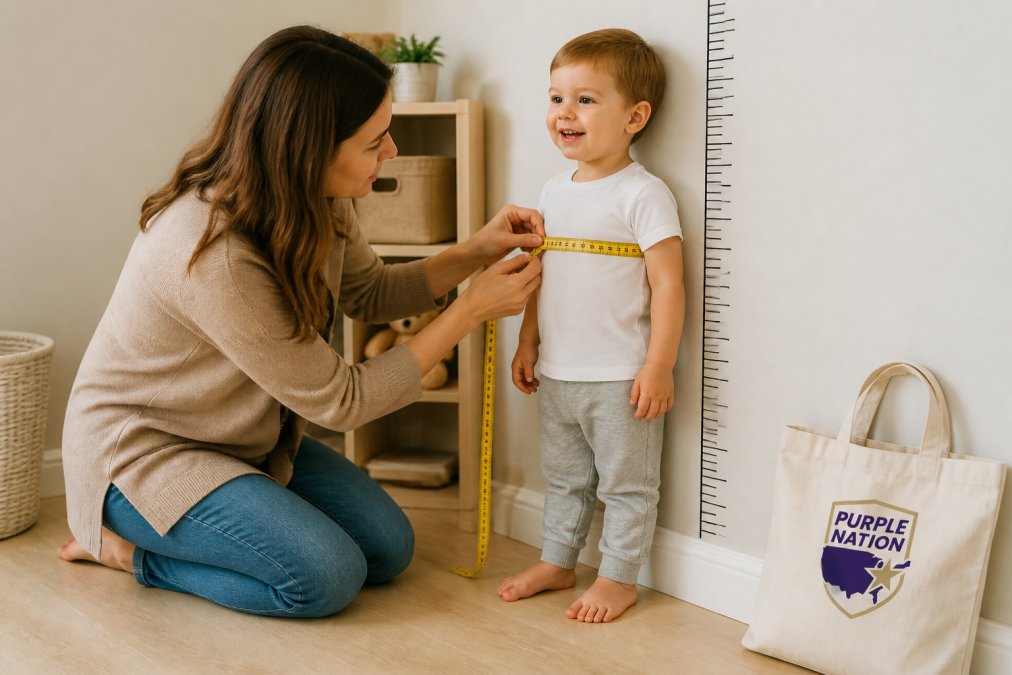
Write the numbers down and keep them in your phone. Toddler growth spurts move fast, and having last month's measurements on hand tells you whether to size up before you order.
Chest and Waist Measurement Guides
Chest circumference decides whether a shirt pulls across the shoulders; waist measurement decides whether pants stay up during a tantrum. For most toddlers, chest measurements land between 20 and 23 inches across sizes 2T to 5T, and waists between 19 and 22 inches.
The CDC growth charts for children ages 2 to 20 are a useful reference for checking whether your child's height and weight sit near the middle or the edges of their age group. A toddler tracking at the high end of the range will almost always need the larger size.
If the chest measurement puts your child in 3T but the waist says 2T, buy the 3T. Sleeves and shoulders are harder to work around than a waistband, and a drawstring or elastic waist forgives an inch of extra room.
Size Conversion by Weight and Height
Weight and height together beat age alone for fit accuracy. A toddler's weight tells you how much room the garment needs through the torso; height tells you whether the clothing length will cover the ankles and wrists. Age is a starting point; these two numbers are the decision.
Use this conversion logic:
- Under 25 lb and under 33 in: 18M or 24M
- 25-28 lb and 33-35 in: 2T
- 28-32 lb and 35-38 in: 3T
- 32-36 lb and 38-41 in: 4T
- 36-42 lb and 41-44 in: 5T
When the two signals disagree, height wins for tops and weight wins for bottoms. A long, lean toddler needs the taller size in a tee and possibly the smaller size in shorts.
Toddler Short Sleeve T-Shirt →
Two Factors That Break Every Conversion Chart
A weight-and-height chart assumes the garment you buy today will fit the same way after a month of wear. It usually will not, and two factors explain most of the drift.
Fabric shrinkage. Cotton jersey and cotton-blend fleece can shrink after the first few washes, especially in a hot dryer. A 100% cotton tee may lose noticeable length; a cotton-polyester blend holds its shape better. If you are buying a pure-cotton tee for a toddler sitting right at the top of a size band, size up rather than trusting the chart to hold. A cotton-polyester fleece, like the blend used in the JMU Nation Toddler Hoodie, resists that shrinkage and stays closer to its labeled size.

Diaper bulk. A toddler still in diapers needs extra room through the seat and waist that a chart built on bare measurements will not show.
How to Apply the Chart in Practice
- Measure height and weight first, then find the band your child lands in.
- Check the fabric. Pure cotton gets a size-up hedge if your child is near the top of the band; a cotton-poly blend does not.
- Check the diaper status. Still in diapers, especially cloth, means bottoms go up a size.
- Confirm against the brand's own chart. The band above is a starting range, not a guarantee for every label.
This is where a toddler clothes size chart on a retailer's page earns its keep. Purple Nation lists available sizes on each product page, including 18M through 4T on the JMU Toddler Short Sleeve T-Shirt, so you can match your measurements to what is actually in stock.
Infant Sizing vs. Toddler Sizing: What Changes
Infant sizing is built around a baby who lies down, gets carried, and wears a diaper full time. Toddler sizing is built around a child who walks, climbs, and moves constantly. That shift changes the garment, not just the number on the tag.
The practical differences:
- Shoulders: toddler tops have wider, squarer shoulders for arm movement
- Torso: infant onesies run long to accommodate diapers; toddler tees are cut shorter
- Openings: infant clothing favors snaps and envelope necks; toddler clothing favors pull-on and crew necks
- Durability: toddler seams take far more abuse from crawling and playgrounds
Fabric Shrinkage, Diaper Bulk, and Brand Variance
Three factors quietly break size charts, and most fit guides skip all three. Fabric shrinkage, diaper bulk, and brand variance explain why the same 3T fits differently across two orders.
Best Places to Buy JMU Apparel for Toddlers
The best place to buy JMU apparel for toddlers is a retailer that stocks the small sizes consistently, publishes measurements, and carries officially licensed gear. Plenty of stores sell adult JMU gear and treat toddler sizes as an afterthought, which is why parents end up hunting across three sites for one 3T tee.
- JMU Toddler Short Sleeve T-Shirt in sizes 18M, 2T, 3T, and 4T, with the Duke Dog mascot front and center
- Toddler Short Sleeve T-Shirt in 100% combed ringspun cotton with an EasyTear label
- JMU Nation Toddler Long Sleeve T-Shirt in cotton jersey with ribbed cuffs
- JMU Nation Toddler Hoodie in a cotton-polyester fleece blend
Conclusion
Toddler sizing rewards parents who measure instead of guessing. Get the height, chest, and waist numbers, check the specific brand's chart, and size up whenever your child sits between two sizes. That approach turns a frustrating search into a two-minute decision.


Frequently Asked Questions
Do 2-year-olds typically wear 2T or 3T?
Most 2-year-olds fit best in 2T, which is cut for children roughly 30 to 33 inches tall and 24 to 28 pounds. If your toddler is above average height or weight, or if they are in the middle of a growth spurt, 3T may give more room. Always check the specific toddler clothes size chart from the brand you are buying, since a 2T from one maker can fit like a 3T from another.
How do I measure my toddler for apparel at home?
Use a soft measuring tape and have your child stand relaxed in a diaper or light clothing. Measure chest circumference at the fullest part, waist at the natural crease above the hips, and height from the top of the head to the floor. Write the numbers down and compare them to the brand's size chart. If your child falls between two sizes, size up for growing room.
Are toddler sizes consistent across different brands?
No. Standardized sizing does not exist for toddler apparel, so a 3T from one label may fit like a 2T from another. Garment dimensions, fabric shrinkage, and cut all vary. Read each brand's fit guide before ordering, and when in doubt, size up. For JMU toddler gear, checking the product page details helps you pick the right fit the first time.
How should I account for growth spurts when buying toddler clothes?
Buy for the size your toddler is growing into, not the size they are leaving behind. Toddlers can jump a full size in three to four months. If your child is near the top of a size range, move up. Slightly roomy sleeves and hems are easier to manage than a shirt that is too tight after one wash.