

Table of Contents
- Why Verification Matters: The Benefits of Buying Officially Licensed Apparel
- What Does Officially Licensed Apparel Actually Mean?
- Physical Markers: How to Verify Officially Licensed Apparel Step by Step
- How to Spot Fake University Merchandise: Red Flags That Matter
- Digital Verification Tools and Third-Party Licensor Links
- Finding Authorized Collegiate Apparel Retailers You Can Trust
- Legal Risks for Resellers and What Copyright Lines Protect
- Frequently Asked Questions
Last Updated: September 11, 2026
Why Verification Matters: The Benefits of Buying Officially Licensed Apparel
Counterfeit collegiate merchandise costs fans more than they realize. Knowing how to verify officially licensed apparel protects you from overpaying for inferior goods while making sure the people who make team gear get paid.

The benefits of buying officially licensed apparel go beyond supporting the school. Licensed products pass quality review before reaching a shelf, which means better stitching, accurate colors, and graphics that don't peel after two washes.
Real authentication involves several markers working together, and counterfeiters rarely replicate all of them at once. Here's how to inspect a garment in under two minutes.
What Does Officially Licensed Apparel Actually Mean?
Officially licensed apparel is clothing and merchandise produced under a legal agreement between a manufacturer and the trademark owner, which for collegiate products is usually the university acting through a licensing agent. That agreement gives the maker permission to use team logos, names, and mascots in exchange for royalty payments and design approval.
Most universities work with a licensing agency that approves every design and requires manufacturers to print a copyright line on the item itself, your proof of authorization.
For fans, the practical difference shows up in three places:
- Print quality: Licensed graphics are color-matched to official team palettes and tested for wash durability.
- Fabric composition: Licensees must meet minimum material standards, so a licensed tee feels like a real tee.
- Accountability: If something is wrong, there's a paper trail back to the manufacturer.
Physical Markers: How to Verify Officially Licensed Apparel Step by Step
Verifying officially licensed apparel takes about two minutes. Work through these three checks in order to catch the vast majority of counterfeits before you buy.
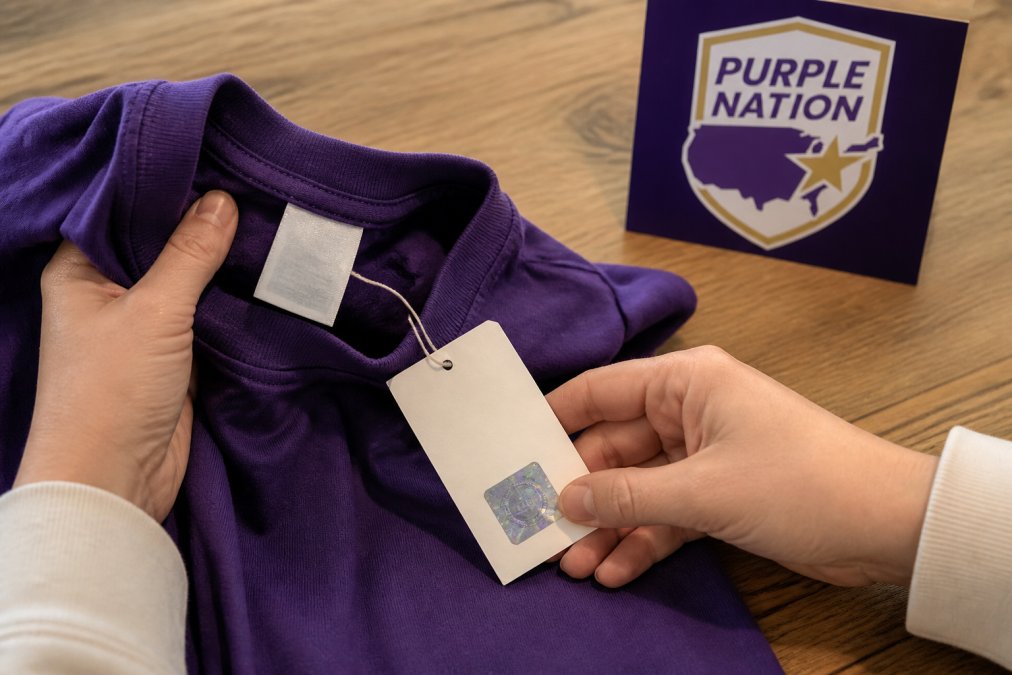
Check the Hangtag and Woven Label
A legitimate hangtag carries the licensing agency's official seal alongside the team mark, plus a printed copyright line, the manufacturer's name, and a licensor reference. The woven label inside the neck should list fabric composition and care instructions in clean, evenly spaced type.
Counterfeiters often print labels on flimsy paper stock with blurry logos, while licensed woven labels have crisp edges and consistent thread density.
Find the Hologram Sticker and Serial Number
Higher-value licensed items often carry a hologram sticker with a serial number beneath it. The hologram shifts color when tilted, and the serial number should be unique. If the sticker peels off cleanly or the serial number repeats across items in the same bin, walk away.
Not every licensed product has a hologram. Its absence alone isn't proof of a fake, but its presence with a matching serial number is strong evidence of authenticity.
Read the Copyright Line and Care Instructions
The copyright line is the single most reliable marker. It typically reads as the university name followed by a registered trademark symbol and the phrase "officially licensed," often with the licensing agency named. A missing line is a red flag.
Care instructions matter too. Licensed manufacturers print specific wash temperatures and drying guidance because they've tested the fabric. Vague instructions like "machine wash" with no temperature suggest the maker never tested anything.
| Marker | What to Look For | Red Flag |
|---|---|---|
| Hangtag | Official seal, copyright line, manufacturer name | No licensor reference |
| Woven label | Crisp lettering, fabric composition listed | Blurry print, paper label |
| Hologram | Color-shifting sticker, unique serial number | Repeated serial numbers |
| Copyright line | University name, trademark symbol, licensor | Line missing entirely |
| Care instructions | Specific wash temperature and drying method | Vague or generic guidance |
How to Spot Fake University Merchandise: Red Flags That Matter
Knowing how to spot fake university merchandise comes down to noticing what's absent. Counterfeiters copy the visible logo and skip everything the buyer can't see at a glance. Compare a real garment against a suspected fake on the same five points, in the same order, every time.
Real vs. Fake: A Side-by-Side Comparison
Use this framework when you have both items in hand, or when comparing a listing photo against a garment you already own.
| Inspection Point | Licensed Product | Counterfeit |
|---|---|---|
| Team color | Matches the official palette exactly; consistent across the whole run | Slightly off, purple leans blue, gold reads mustard, red reads orange |
| Graphic feel | Screen print flexes with the fabric and stretches without cracking | Heat transfer feels stiff or plastic; cracks along the edges when stretched |
| Stitch density | Even spacing, no loose threads, seams lie flat | Uneven spacing, skipped stitches, puckered seams |
| Label stock | Woven label with crisp edges and consistent thread density | Printed paper label with blurry lettering or a scanned-looking logo |
| Tag attachment | Hangtag fastened with a plastic barb or sewn loop | Tag stapled on, taped on, or missing entirely |
The Five Red Flags That Matter Most
- Colors that are slightly off. Official team colors are specified in the licensing agreement. A purple that leans blue or a gold that looks mustard usually means nobody approved the design.
- Graphics that feel stiff or plastic. Licensed screen printing flexes with the fabric. Cheap heat transfers crack when you stretch them.
- No vendor list presence. Authorized retailers appear on the university's or licensor's published vendor list. If a seller isn't on it, ask why.
- Prices that seem too good. Authentic collegiate products carry royalty costs. A price far below everyone else's usually means those costs were skipped.
- Stock photos instead of real product images. Sellers who never photograph the actual item often don't have it.
Where Counterfeits Hide
Don't assume a physical store guarantees authenticity. Counterfeit merchandise shows up at flea markets, pop-up tents, and small shops that buy from unverified wholesale distributors. Online, watch for sellers with a deep catalog of one school's gear but no other licensed brands, listings reusing the same photo across colorways, and shipping windows measured in weeks rather than days.
A Two-Minute Field Test
If you only have a minute in a store: flip the neck label and read the copyright line, tilt the hangtag toward a light to check for a hologram, stretch the graphic gently to see whether it flexes or cracks, and compare the team color against a photo on your phone. If two or more fail, put it back.
Digital Verification Tools and Third-Party Licensor Links
Digital verification is the fastest check available. Most collegiate licensing agencies publish searchable databases of approved licensees, and a quick lookup settles the question in seconds.
Here's the process:
- Note the manufacturer's name from the hangtag or woven label.
- Search the licensing agency's published licensee directory for that manufacturer.
- Check the university's trademark and licensing office page for its official vendor list.
- Cross-reference the retailer against that list before you buy.
Third-party verification matters because it removes the seller from the equation. You're not trusting a store's claim; you're trusting the licensor's own records. As the U.S. Patent and Trademark Office trademark basics guide explains, trademark owners have both the right and the obligation to control who uses their marks, which is exactly why these directories exist.
For vintage authentication, older licensed pieces may predate current hologram systems, so lean on the copyright line, the licensor name of that era, and construction quality. Collector communities often maintain reference archives for specific decades.
International Trademark Association resources on brand verification maintains broader guidance on how licensing programs are structured, which helps when you're evaluating a manufacturer you've never heard of.
Finding Authorized Collegiate Apparel Retailers You Can Trust
Authorized collegiate apparel retailers share one trait: they can tell you exactly who licensed the product and where it was made. If a retailer can't answer that, the answer is no.
The Four Questions to Ask Any Retailer
- Who is the licensor on this item? A legitimate retailer can name the licensing agency or the university's trademark office without checking.
- Which manufacturer produced it? The answer should match the name on the woven label or hangtag.
- Is this retailer on the university's published vendor list? If the retailer hesitates, that's your answer.
- Can I see the copyright line on the tag? A retailer that stocks licensed goods will hand you the garment without flinching.
How to Verify the Answer Yourself
Don't take the retailer's word for it. Cross-check in three places:
- The university's trademark and licensing office page, which typically lists approved vendors by category (apparel, headwear, accessories, tailgate).
- The licensing agency's published licensee directory, which lists manufacturers authorized to produce the school's marks.
- The manufacturer's own website, which usually names the schools it holds licenses for. A manufacturer that lists dozens of schools but not the one on the tag is a red flag.
The licensor's own records are the only source that removes the seller from the equation entirely.
What Depth of Selection Signals
Look for retailers carrying a deep, consistent selection rather than a random assortment. Depth signals a real relationship with licensees: a retailer with one hat and one tee in one size is likely reselling whatever they could source, while one stocking infant, toddler, youth, and adult sizes across multiple categories has an established buying relationship.
Purple Nation operates boutiques inside three Virginia stores, at The Boutiques at Virginia Beach on Laskin Road, and inside Lazy Daisy locations in Short Pump and on Hull Street in Midlothian. Every item we carry is a licensed product, and our flags and banners are produced under CLC licensing, so the copyright line is right there on the tag.
Buying Online From Out of State
For alumni shopping out of state, ask the retailer to confirm the licensor before you check out. On marketplace listings, check whether the seller name matches a manufacturer on the licensee directory, mismatches are the most common signal of an unauthorized reseller.
When the Retailer Is Also the Manufacturer
Some of the strongest signals come from retailers that also hold a manufacturing license. If a shop's name appears on the licensee directory as a manufacturer, the copyright line on the tag will match the store you're in, the cleanest verification you can get without opening a database.
Legal Risks for Resellers and What Copyright Lines Protect
Reselling unlicensed merchandise carries real legal exposure. Unauthorized use of a university's marks is infringement, and enforcement actions target resellers as well as manufacturers.
The copyright line on a licensed product isn't decoration. It documents the chain of authorization, which a reseller needs if a question arises about where the goods came from.
What copyright lines protect:
- The university's intellectual property, including logos, names, and mascots.
- The licensee's investment, since they paid for the right to produce the design.
- The buyer, who gets a product that meets standards and can be traced if something goes wrong.
A reseller who can show a clean path from licensor to shelf has a defensible position. One who can't is exposed, even if they bought in good faith.
For fans, this still matters: every licensed purchase keeps the licensing system funded, which pays for the design review and quality standards that make licensed gear worth buying.
The Federal Trade Commission guidance on deceptive advertising is worth knowing if you ever resell, because misrepresenting an unlicensed item as official falls squarely under consumer protection rules.
Counterfeit merchandise is getting harder to spot, making verification a skill worth building. A hangtag, a woven label, a hologram, and a copyright line together give you a reliable answer in under two minutes, and digital licensee directories close the loop when you're buying online.
At Purple Nation, we stock licensed JMU gear for every age, from infant and toddler sizes through adult apparel, along with accessories, home goods, and tailgate essentials. Every product carries the licensing documentation that makes verification straightforward, and our boutiques in Virginia Beach, Short Pump, and Midlothian let you inspect the tags in person before you buy. Add to cart with confidence and represent the Dukes in gear that's the real thing.
Frequently Asked Questions
What does officially licensed apparel mean?
Officially licensed apparel carries permission from the trademark owner, such as a university, to use its logos and names. The licensor grants this right through a formal agreement, and the manufacturer pays royalties on each item sold. Legitimate products display a copyright line, a hangtag, and often a hologram sticker from the licensing body. Without that permission, the item is counterfeit merchandise, regardless of how good the print quality looks.
How can I tell if a clothing item is officially licensed?
Start with the tag. Look for a woven label or hangtag showing the licensor's name, a copyright symbol, and a serial number or hologram sticker. Check the print quality of the graphic: licensed items use clean silk screen or embroidery with sharp edges. Then verify the seller appears on the university's vendor list or a third-party licensor's authorized retailer directory. If any of those markers are missing, treat the item as unverified.
Do officially licensed products have a specific hologram or tag?
Many do, but not all. Collegiate licensing bodies often issue hologram stickers with serial numbers that appear on the hangtag or label. Some licensors use woven labels with the copyright line instead. The presence of a hologram is a strong signal, but the absence does not automatically mean the item is fake. Use the hologram alongside other checks like vendor list verification and print quality.
Where can I find a list of authorized retailers for collegiate gear?
University athletics and licensing offices usually publish a vendor list on their official websites. Third-party licensors also maintain directories of authorized retailers. You can also ask the retailer directly which licensor they work with and request the copyright line on their products. If a seller cannot name their licensor or point to a vendor list, that is a red flag worth taking seriously before you buy.